Hamilton & Chase Tours
Sicily: Ancient Fire & Baroque Stone — Bespoke 8-day Sicily tour: Valley of the Temples, Baroque UNESCO towns, and the most active volcano in Europe.

8-Day Bespoke Journey

Sicily: Ancient Fire & Baroque Stone

Valley of the Temples, Baroque UNESCO towns, and the most active volcano in Europe.

Available as Private Semi-Private Self-Guided
From €2,890 per person 8 days / 7 nights
View Itinerary

Tour Overview

8 days across Sicily.

Sicily is not simply another Italian region. It was Greek before it was Roman, Arab before it was Norman, and its food, language, and architecture carry every layer of that history simultaneously. The Valley of the Temples at Agrigento is better preserved than anything on the Greek mainland. The Arab-Norman cathedral of Monreale outside Palermo contains the most complete Byzantine mosaic cycle outside Hagia Sophia. The Baroque towns of the southeast — Ragusa, Noto, Modica — were rebuilt after a 1693 earthquake in a style so coherent that UNESCO designated the entire group as a single World Heritage Site. And at the northeast corner of the island, Etna is the most active volcano in Europe, still building itself, visible from almost everywhere on the island as a reminder that this landscape is not finished. This eight-day journey is for travellers who want to understand Sicily rather than simply photograph it.

Detailed Itinerary

Your journey, day by day.

Every day is designed with breathing room. Sleep in, take a detour, linger at lunch — the itinerary flexes around you, not the other way around.

Day 1 — Palermo: The Arab-Norman Capital
Day 1
1

Day 1

Palermo: The Arab-Norman Capital

The most layered city in the Mediterranean.

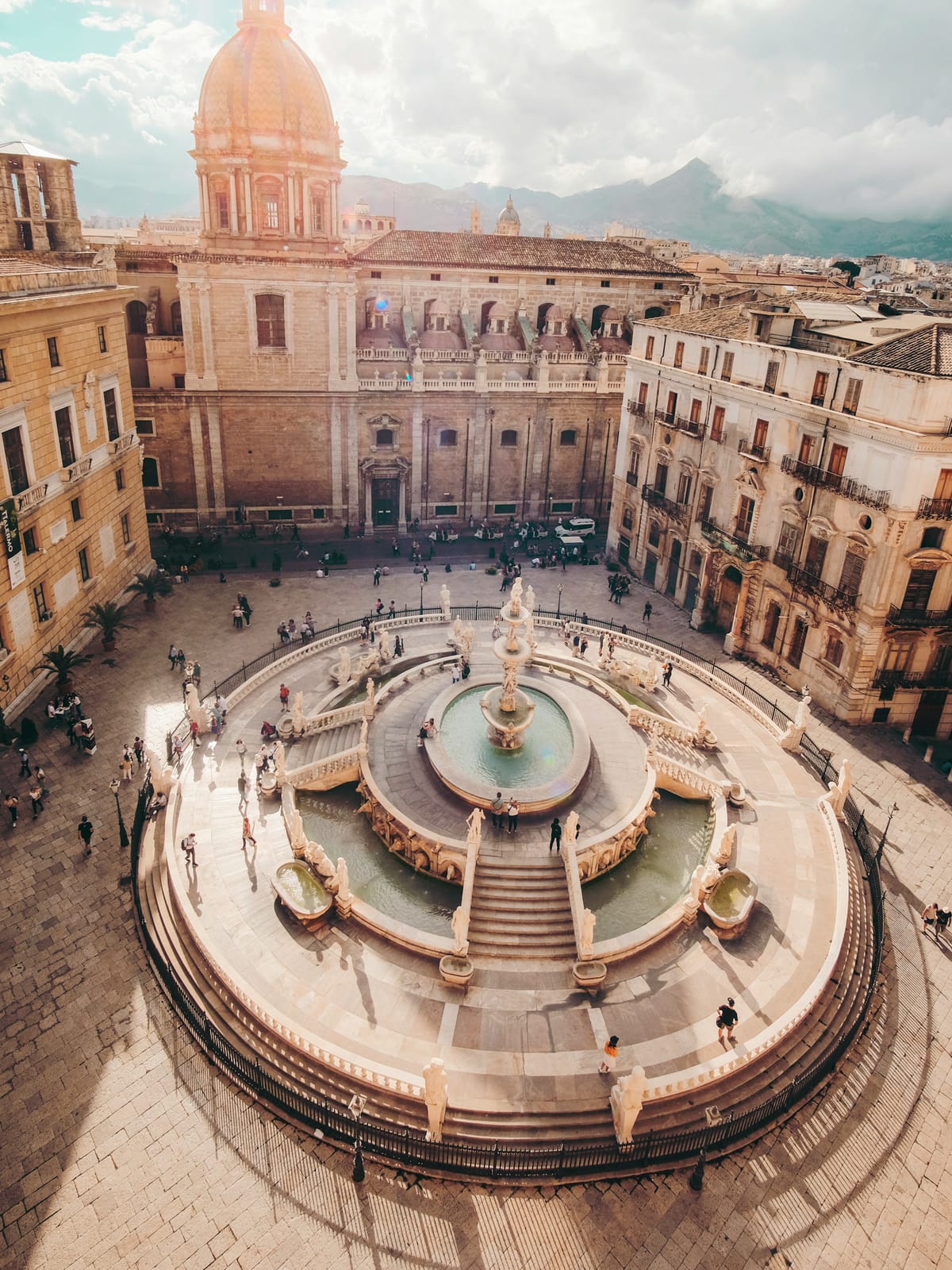
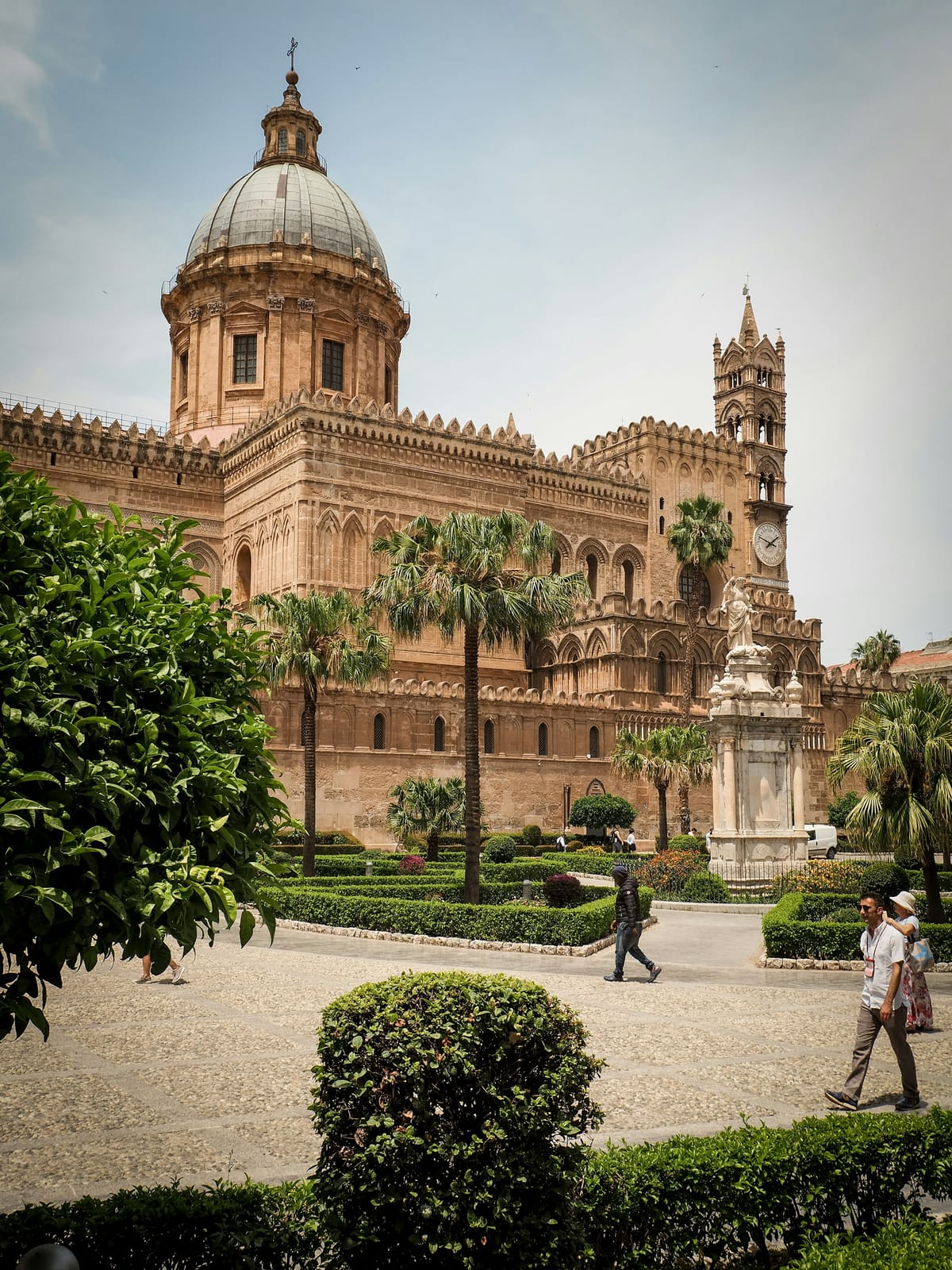
Palermo is one of the most historically complex cities in Europe — twelve civilisations have left physical traces here that can be seen simultaneously on a single walk. Your private guide meets you after the transfer from Palermo airport for an afternoon introduction to the Arab-Norman itinerary: the Palazzo dei Normanni with its extraordinary Cappella Palatina, whose gold mosaics cover every surface of a room that is simultaneously a Norman palace chapel, an Arab muqarnas ceiling, and a Byzantine theological programme. The cathedral of Monreale just outside the city contains the most complete cycle of medieval mosaics in the world after Hagia Sophia — the guide explains the political theology behind them, commissioned by William II as a statement of Norman divine authority. Dinner in Palermo's Ballarò market neighbourhood: the street food tradition here — panelle, sfincione, arancini — is the most Arab-influenced in Italy, and the restaurants that surround it serve the cucina palermitana that the island has been refining for a thousand years.

  • Cappella Palatina — Arab-Norman-Byzantine mosaics
  • Monreale Cathedral's complete mosaic cycle
  • Ballarò market neighbourhood and Palermitano street food
  • Private airport transfer
5★ hotel, Palermo historic centre
Day 2 — Palermo: The Markets and the Mafia
Day 2
2

Day 2

Palermo: The Markets and the Mafia

A city understood through its food and its complexity.

Palermo is a city that rewards slow walking more than directed sightseeing. Your morning is with a local guide who has spent thirty years mapping the city's neighbourhoods — the Vucciria market, older than the city's Arab period, where fishermen sell swordfish and sea urchin from trestle tables at seven in the morning; the Quattro Canti Baroque crossroads; the Palazzo Abatellis with its extraordinary Flemish Annunciation and the terrifying 15th-century Triumph of Death fresco. A lunch of pasta con le sarde — the quintessential Palermitano dish of pasta, fresh sardines, wild fennel, pine nuts, and raisins that is untranslatably of this island — in a restaurant that has been serving it in the same form since 1970. In the afternoon, the Palermo Catacombs of the Capuchins, whose 8,000 preserved and dressed corpses from the 16th to 19th centuries constitute the most unusual and memorable memorial anywhere in Italy. The drive south to Agrigento begins after dinner.

  • Vucciria market at dawn — swordfish, sea urchin, street food
  • Palazzo Abatellis and the Triumph of Death
  • Pasta con le sarde — the quintessential Sicilian dish
  • Capuchin Catacombs — 8,000 preserved inhabitants
Meals: Breakfast 5★ hotel, near Agrigento
Day 3 — Agrigento: The Valley of the Temples
Day 3
3

Day 3

Agrigento: The Valley of the Temples

Better preserved than anything on the Greek mainland.

The Valley of the Temples is one of the great archaeological sites on earth — a ridge outside the modern city where seven Greek Doric temples from the 5th century BC stand in varying states of preservation above the Sicilian plain, with the sea visible in the distance. The Temple of Concordia is among the best-preserved Greek temples anywhere, its columns still standing and roofed, converted to a church in the early Christian period which is precisely what saved it. Your private guide visits the site in the late afternoon when the heat is softer and the light is horizontal and golden — the stone turns amber, the shadows lengthen, and the site takes on the quality of a landscape painting. The visit includes the archaeological museum, where the reconstructed Telamon figure from the Temple of Zeus gives a sense of the scale of what was once here. Dinner in a restaurant above the valley where the temples are visible from the table, lit at night.

  • Temple of Concordia — the best-preserved Greek temple outside Greece
  • Valley of the Temples in the golden afternoon hour
  • Archaeological Museum — reconstructed Telamon figure
  • Dinner with illuminated temple views
Meals: Breakfast 5★ hotel, Agrigento area
Day 4 — Baroque Sicily: Ragusa & Modica
Day 4
4

Day 4

Baroque Sicily: Ragusa & Modica

The earthquake that created a unified aesthetic.

After the Val di Noto earthquake of January 1693 destroyed most of southeastern Sicily, the rebuilding was done simultaneously, with enough money and intention to produce a consistent Baroque aesthetic across a dozen towns. The result is a UNESCO World Heritage Site — not individual buildings but an entire cultural landscape. Ragusa Ibla, the ancient lower town, is the most perfect example: a Baroque hilltown rebuilt on medieval foundations, its cathedral of San Giorgio by Rosario Gagliardi visible for miles, its streets free of traffic and its residents still cooking from market ingredients. Modica is famous worldwide for its chocolate — made to the pre-Columbian Aztec method without added fat, with a grainy texture and an intense flavour that bears no relation to commercial chocolate. A mid-afternoon stop at one of the historic chocolate laboratories reveals a three-hundred-year-old technique that the town has refused to modernise.

  • Ragusa Ibla — the most perfect Baroque hilltown in Sicily
  • San Giorgio Cathedral by Gagliardi
  • Modica chocolate laboratory — Aztec method, cold-worked
  • Val di Noto UNESCO landscape
Meals: Breakfast 5★ hotel, Noto area
Day 5 — Noto: The Perfect Baroque City
Day 5
5

Day 5

Noto: The Perfect Baroque City

Built in a single aesthetic vision, it has never been diluted.

Noto was rebuilt entirely from new after 1693 on a new site a kilometre from its destroyed predecessor. The planning was deliberate: a single street grid with wide corsi and piazzas aligned with the sun, every building in the local Pietra di Noto limestone that weathers from cream to amber over centuries. The Corso Vittorio Emanuele has been called the most beautiful street in Italy by people who have seen all the competition. Your morning is a walking tour with a local architectural historian: the Cathedral, the Palazzo Ducezio, the monastery of Montevergine converted to a cultural centre, the side streets where the aristocratic palaces have elaborately carved consoles holding their wrought-iron balconies. Lunch at a restaurant in the historic centre, then an afternoon at leisure — the granita and brioche from a bar on the corso is obligatory, a Sicilian tradition of cold almond or lemon ice with a sweet brioche bun that makes the Sicilian breakfast the best in Italy.

  • Corso Vittorio Emanuele — the most beautiful street in Italy
  • Private architectural tour with specialist guide
  • Noto's aristocratic palaces and carved balconies
  • Granita and brioche — the Sicilian breakfast at its best
Meals: Breakfast 5★ hotel or boutique palazzo, Taormina
Day 6 — Taormina: The Grand Tourists' Favourite
Day 6
6

Day 6

Taormina: The Grand Tourists' Favourite

The Greek theatre above the sea with Etna as its backdrop.

Taormina was the most visited town in Sicily on the Grand Tour and the reason is immediately apparent: a Greek theatre cut into the cliffside above the Ionian Sea, with Etna visible above the stage and the coastline stretching in both directions. D.H. Lawrence wrote Sea and Sardinia here, Goethe described the view as the most beautiful on earth, and the paintings and photographs of this particular view form one of the most consistent obsessions in the history of travel imagery. Your private guide provides context beyond the aesthetics: the Greek political reason for building the theatre here in the 4th century BC, the Roman alterations for gladiatorial combat, the medieval conversion to defensive use. The afternoon is for the town itself — the Corso Umberto, the public garden planted by a Victorian Englishwoman in the 1880s, and the cable car down to the beach at Isola Bella for a late swim in the Ionian Sea.

  • Greek Theatre of Taormina — Etna above the stage, sea below
  • Private archaeological tour with context beyond the view
  • Corso Umberto and Victorian public gardens
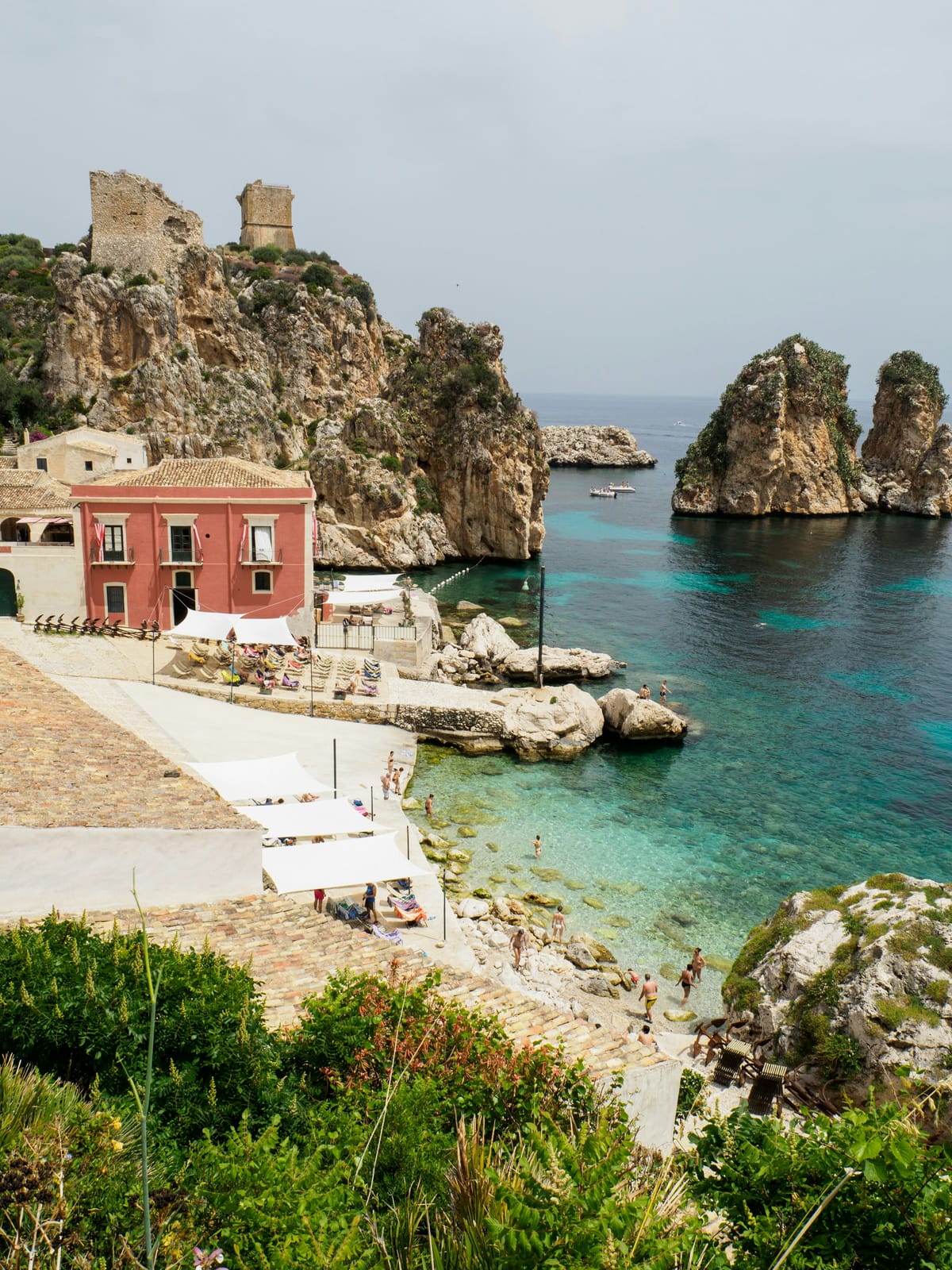
  • Cable car to Isola Bella beach for a late swim
Meals: Breakfast 5★ hotel, Taormina
Day 7 — Etna: Walking the Volcano
Day 7
7

Day 7

Etna: Walking the Volcano

The most active volcano in Europe is still building itself.

Etna is not a destination — it is a presence that has defined Sicilian life since before recorded history, and its most recent eruptions were in 2023. Your guide today is a volcanologist who has been monitoring and walking Etna for fifteen years. The ascent by cable car and off-road vehicle reaches 2,900 metres on the southern flank, where the craters from the last significant eruptions are visible as black wounds in the landscape, still warm, with sulphur vapour rising from the fumaroles. The terrain is extraordinary: a moonscape of hardened lava flows in every shade from brown to copper to jet black, dotted with wild fennel and the first plants that colonise fresh lava. The views from this altitude — the whole island visible on clear days, the sea on three sides, the Calabrian coast on the mainland across the strait — are unlike anything available from a viewpoint. Lunch at an Etna wine estate: the volcanic soil grows Nerello Mascalese, one of the great red grapes of southern Italy, which the recent international attention to Etna wine has made considerably harder to find at cellar prices.

  • Etna crater walk at 2,900 metres with volcanologist guide
  • Recent lava fields and active fumaroles
  • Panoramic views — Sicily, the Strait of Messina, Calabria
  • Etna wine estate lunch — Nerello Mascalese
Meals: Breakfast 5★ estate or hotel, Etna slopes
Day 8 — Departure
Day 8
8

Day 8

Departure

The island stays with you in the aftertaste of everything.

Your last Sicilian morning is at leisure — the volcanic slopes of Etna are covered in citrus orchards, pistachio groves, and the chestnut forests that produce the Etna Castagno so prized in Italian cooking. A breakfast of ricotta and honey and the blood oranges of the Etna terraces before your private transfer to Catania airport. Sicily has a way of feeling incomplete when you leave — there is always the southwest with its ancient salt flats and tuna runs, the Greek temples of Selinunte, the Norman mosaics of Cefalù — which is, perhaps, the intended feeling.

  • Final Etna morning — citrus orchards and volcanic landscape
  • Ricotta, honey, and Etna blood oranges for breakfast
  • Private transfer to Catania airport
Meals: Breakfast

Where You'll Stay

Hand-picked hotels, every night.

We choose properties for character, location, and the kind of service that makes you feel looked after — not just checked in. Every hotel can be swapped for an alternative if you prefer.

5★ hotel, historic centre, Palermo

Palermo

1 night

5★ hotel, historic centre

Near the Palazzo dei Normanni

Walking distance to the Ballarò market and the Arab-Norman monuments

5★ hotel, Agrigento area

Agrigento area

1 night

5★ hotel

Near the Valley of the Temples

Close enough to visit the temples at dusk and see them lit at night

5★ hotel or boutique palazzo, Noto / southeastern Sicily

Noto / southeastern Sicily

2 nights

5★ hotel or boutique palazzo

Val di Noto Baroque zone

Within the UNESCO heritage area; Ragusa, Modica, and Noto all within thirty minutes

5★ hotel, Taormina

Taormina

2 nights

5★ hotel

Historic centre above the sea

Walking distance to the Greek Theatre; views of Etna and the Ionian Sea from the terrace

5★ wine estate or boutique hotel, Etna slopes

Etna slopes

1 night

5★ wine estate or boutique hotel

Southern or eastern Etna slopes

A wine estate stay on the volcanic soil — the best base for the crater walk

Hotels shown are indicative of the standard we book. Upon request, we will provide a detailed itinerary with specific hotel options tailored to your preferences and budget.

What's in the Price

Included

  • 7 nights in 5★ hotels and estate properties
  • Daily breakfast at your hotel
  • Etna crater walk with volcanologist guide
  • Private guided visits: Palermo, Agrigento Valley of Temples, Ragusa, Noto, Taormina
  • Monreale Cathedral private guided visit
  • All private vehicle transfers throughout
  • All entrance fees for guided visits
  • 24/7 travel specialist support
  • Hamilton & Chase digital travel booklet with regional culinary guide

Not Included

  • International or domestic flights to/from Sicily
  • Travel insurance (required — we can arrange on request)
  • Meals not listed
  • Personal expenses
  • Gratuities for guides and drivers

Good to Know

  • July and August in Sicily are extremely hot (35–40°C) — we strongly recommend April–June or September–November for the best experience.
  • Etna's crater access is subject to volcanic activity — your specialist will confirm current access levels. We always have alternative programs if the summit is closed.
  • This itinerary begins in Palermo and ends in Catania; both have direct international connections.
  • Sicily can also be combined with a mainland Italy program — Palermo and Catania are short flights from Rome or Milan.

Make It Yours

Optional add-ons & upgrades.

Every trip is different. These extras can be woven into your itinerary — just let your travel specialist know what catches your eye.

Selinunte extension

A half-day addition to the Greek temples of Selinunte on Sicily's southwestern coast — the largest Greek temple precinct in the world, almost entirely unexcavated

Price on Request

Private boat to the Aeolian Islands

A day on a private sailing boat from Taormina or Milazzo to the volcanic Aeolian Islands — Stromboli's active crater visible from the sea, Lipari's obsidian beaches

Price on Request

Marsala wine estate visit

The wine that Nelson kept his fleet on — a private visit to a Marsala producer in western Sicily, with a vertical tasting in the old wooden casks

Price on Request

Palermo cooking class

A morning class with a Palermitano chef: arancini, caponata, pasta 'ncasciata — the dishes that carry the island's layered history in their ingredients

Price on Request

"Walking on Etna with a volcanologist who could explain what we were standing on — still-warm lava from three years ago, sulphur coming out of the ground, and the whole island visible — was completely unlike anything we have ever done. Sicily itself is unlike anything else."

David & Marina H.

Sydney, Australia · Sicily: Ancient Fire & Baroque Stone, October 2024

Common Questions

Questions about this trip.

Is the Etna walk suitable for non-hikers?

The cable car and off-road vehicles do most of the work — the final section on foot is around forty-five minutes at altitude on uneven volcanic terrain. The pace is very moderate. Guests with limited mobility can take the vehicles to a viewpoint at around 2,500 metres without the final walk.

What is the best season for Sicily?

April through early June and late September through November. The spring wildflowers on the Etna slopes and in the Valley of the Temples are extraordinary in April. October brings the grape harvest, the olive picking begins in November, and the Baroque towns are at their quietest.

Bespoke Journey

Sicily: Ancient Fire & Baroque Stone

8 days / 7 nights

From €2,890

per person

Ready to go?

Share a few details and a specialist will reply within one business day.

More Sicily Tours

Prefer to Talk?

Available Mon–Fri 9am–6pm CET.
On-trip support is 24/7.

Plan My Trip