Hamilton & Chase Tours
Rome: The Hidden City — Bespoke 6-day Italy tour: The Sistine Chapel before anyone else, a fresco restoration studio, and a private palazzo dinner.

6-Day Bespoke Journey

Rome: The Hidden City

The Sistine Chapel before anyone else, a fresco restoration studio, and a private palazzo dinner.

Available as Private Semi-Private Self-Guided
From €2,690 per person 6 days / 5 nights
View Itinerary

Tour Overview

6 days across Italy.

Rome is the most visited city in Italy and the most inexhaustible. Most visitors see the Colosseum, the Forum, and the Vatican, tick them off, and leave believing they have seen Rome. They have seen three things from a city of three million years of accumulation — a city where the mediaeval is built on the antique, the Baroque on the mediaeval, and the modern on all three simultaneously, and where the things worth finding are not on the most photographed streets. This six-day private journey is designed for travellers who have either been before or who want to begin differently: the Sistine Chapel before the public enters, the Vatican museums without crowds, the Pantheon at the hour when the oculus light moves across the floor, private palazzo dinners in rooms not accessible to the public, restoration studios where frescoes are being returned to the colours Raphael saw, and the catacombs beneath the Appian Way where Rome buried its dead for five centuries. Everything is arranged; nothing is rushed.

Detailed Itinerary

Your journey, day by day.

Every day is designed with breathing room. Sleep in, take a detour, linger at lunch — the itinerary flexes around you, not the other way around.

Day 1 — Arrival & the Neighbourhood
Day 1
1

Day 1

Arrival & the Neighbourhood

The city before the programme begins.

Rome arrives immediately — from the motorway the city announces itself with umbrella pines and the dome of St Peter's above the roofline, and by the time your driver delivers you to your hotel in the historic centre, the scale of what is here is already apparent through the taxi window. The afternoon is deliberately free: the neighbourhood, whichever it is — the Pantheon quarter, Prati across the Tiber, Testaccio with its market and its Roman slaughterhouse restaurants — on your own terms, with the list of places your travel specialist has prepared. This is a city that rewards walking without a destination. Dinner at a restaurant that your specialist has selected specifically for you, not from a category but from a specific knowledge of what you have told them you like: whether that is a modern Roman kitchen using the ancient flavour combinations, a traditional trattoria whose cacio e pepe is the neighbourhood standard, or an enoteca whose thousand-label list contains mature Barolo at cellar prices.

  • Arrival in the historic centre
  • Neighbourhood at leisure — the first Roman walk
  • Dinner selected to your specific tastes
5★ historic hotel, Rome centro storico
Day 2 — The Vatican: Before the Crowds
Day 2
2

Day 2

The Vatican: Before the Crowds

The Sistine Chapel with nobody else in it.

The Vatican Museums contain one of the most significant art collections in the world and under normal conditions receive 25,000 visitors a day. Your visit is arranged for the private early morning access that opens the museums to a small number of guests before the public gates open at nine. You enter before seven. The Egyptian, Etruscan, and classical galleries are empty; the Gallery of Maps shows Italy's coastline as 16th-century cartographers understood it; the Raphael Rooms — the Stanza della Segnatura, with the School of Athens — are yours alone. The Sistine Chapel is silent. Michelangelo painted the ceiling between 1508 and 1512 while lying on scaffolding in a space that was the principal chapel of the papal court, and the room only makes sense when it is quiet enough to understand what he was doing: not decoration but a cosmological argument in nine central panels, two hundred sibyls and prophets, and the Last Judgement behind the altar that he added twenty years later. Your guide — a Vatican-credentialed art historian — spends ninety minutes in the Chapel before the public enters.

  • Vatican Museums private early access — before 7am
  • Sistine Chapel without the public — ninety minutes with your guide
  • Raphael Rooms: School of Athens at full attention
  • Gallery of Maps and the Egyptian collection
Meals: Breakfast 5★ historic hotel, Rome
Day 3 — The Ancient City
Day 3
3

Day 3

The Ancient City

Two thousand years in a morning walk.

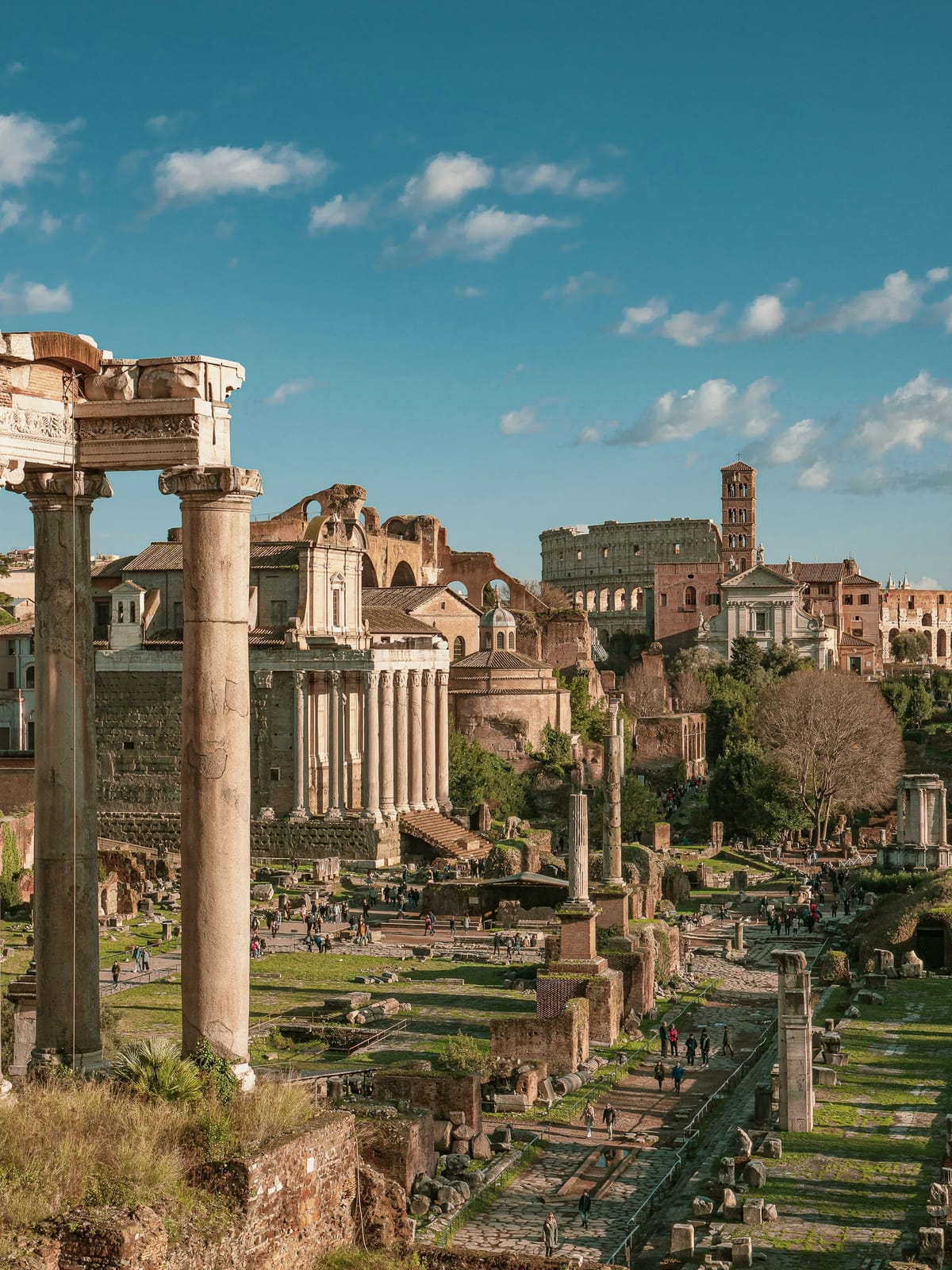
The classical archaeology of central Rome is not a museum — it is a working city built on top of itself over two thousand years, and the best way to understand it is with a guide who can show you the relationship between the layers. Your classicist meets you at the Capitoline Hill: the bronze equestrian statue of Marcus Aurelius in the piazza Michelangelo designed for it, and the view from the back of the hill over the Forum — the Via Sacra, the Arch of Titus, the Temple of Vesta, the Palatine Hill rising above. The Palatine is where the story begins: the shepherds' huts from the 8th century BC, the House of Augustus with its extraordinary frescoed rooms (currently accessible only with advance booking and specialist permission), the palace of Domitian that changed the word 'palace' permanently, and the view from the south wall over the Circus Maximus and the Aventine hill. An afternoon pause before a private dinner arranged in the rooms of a Roman institution — a family whose palazzo in the historic centre is opened occasionally for private evenings, with the family's silver and china laid in a dining room whose frescoes are 18th-century originals.

  • Capitoline Hill — Marcus Aurelius bronze and the Forum view
  • Palatine Hill with classicist guide — House of Augustus frescoes
  • Two thousand years of city-building explained in one walk
  • Private palazzo dinner — family silver, 18th-century frescoed dining room
Meals: Breakfast 5★ historic hotel, Rome
Day 4 — Baroque Rome & the Restoration Studios
Day 4
4

Day 4

Baroque Rome & the Restoration Studios

The artists who made Rome in the 17th century, and the people restoring them now.

The Baroque transformation of Rome was financed by the papacy and executed by Bernini, Borromini, Caravaggio, and a supporting cast of sculptors and architects who remade the city between 1600 and 1680. Your morning is with an art historian who has been working specifically on 17th-century Rome: Piazza Navona and the Fountain of the Four Rivers, Sant'Agnese in Agone (Borromini's concave façade), and then to the churches that the standard itineraries miss — Sant'Ignazio di Loyola, whose ceiling trompe l'oeil by Andrea Pozzo makes the church appear to have a dome when it has none; Santa Maria della Vittoria, whose Cornaro Chapel contains Bernini's Ecstasy of St Teresa in the only spatial arrangement Bernini himself designed for it. The afternoon is exceptional: a private visit to a fresco restoration studio currently working on a commission in one of Rome's major churches. The restorer demonstrates the technique — consolidating loose intonaco, reintegrating lost areas, reading the cartone beneath the surface — and explains what they can see now that the original painters would have seen. This is not a tourist experience; it is a working studio with active obligations.

  • Bernini and Borromini's Rome — the Baroque that remade the city
  • Ecstasy of St Teresa in Bernini's designed Cornaro Chapel
  • Sant'Ignazio's trompe l'oeil dome — the most ambitious illusion in Rome
  • Private fresco restoration studio — active commission in progress
Meals: Breakfast 5★ historic hotel, Rome
Day 5 — The Appian Way & the Underground
Day 5
5

Day 5

The Appian Way & the Underground

Where Rome buried its dead and kept its secrets.

The Via Appia Antica — the Appian Way — was built in 312 BC and runs south from Rome to Brindisi in a nearly straight line for 560 kilometres. The section outside the Aurelian Walls was lined with tombs, columbaria, and eventually Christian catacombs: it was illegal to bury the dead within the city walls, so every road out of Rome became a cemetery. Your morning is on the ancient road itself — basalt paving stones worn by two millennia of traffic, umbrella pines arching over the road, the Tomb of Cecilia Metella visible ahead and the aqueduct arches stretching across the Campagna beyond. The Catacombe di San Callisto hold the remains of nine popes of the 3rd century and hundreds of thousands of early Christians in forty kilometres of underground passages — your private guide descends with you for ninety minutes. The Circus of Maxentius, the Villa dei Quintili whose baths and stadium stretch for a kilometre along the road, and in the afternoon a return to the city through the Trastevere neighbourhood: the dinner in Trastevere at a restaurant that has been serving this neighbourhood since before tourism reached this far across the river.

  • Via Appia Antica — basalt paving stones from 312 BC
  • San Callisto Catacombs private visit — 40km of underground passages
  • Tomb of Cecilia Metella and the Circus of Maxentius
  • Trastevere dinner — the neighbourhood across the Tiber
Meals: Breakfast 5★ historic hotel, Rome
Day 6 — The Pantheon & Departure
Day 6
6

Day 6

The Pantheon & Departure

The most perfect building ever constructed, at the best hour.

The Pantheon was built between 118 and 128 AD and has been in continuous use — as a temple, then a church — ever since, making it the best-preserved building of antiquity. The concrete dome was the largest in the world for thirteen hundred years after it was poured, and the oculus at the top is the only source of light: a nine-metre circular hole through which a column of light moves across the interior floor and walls over the course of the day, reaching the south wall at noon on the summer solstice in what may or may not have been a deliberate astronomical alignment. Your visit is arranged for the first hour after opening, when the morning light enters at a low angle and the building is as Hadrian intended it to be experienced — in reverence and without interruption. Your driver collects you at noon for Fiumicino. Some things are better seen slowly and only once. Rome is not one of those things.

  • Pantheon at opening — the oculus light at its most theatrical
  • The best-preserved Roman building and the largest unreinforced concrete dome
  • Roman coffee and a final walk before the city wakes
  • Private transfer to Fiumicino
Meals: Breakfast

Where You'll Stay

Hand-picked hotels, every night.

We choose properties for character, location, and the kind of service that makes you feel looked after — not just checked in. Every hotel can be swapped for an alternative if you prefer.

5★ historic hotel, centro storico, Rome

Rome

5 nights

5★ historic hotel, centro storico

Near the Pantheon, Campo de' Fiori, or Via Veneto

Our preferred properties are former Renaissance or Baroque palaces within the Aurelian walls — the building is part of the Rome experience. Specific recommendation depends on your dates and preferences.

Hotels shown are indicative of the standard we book. Upon request, we will provide a detailed itinerary with specific hotel options tailored to your preferences and budget.

What's in the Price

Included

  • 5 nights in a 5★ historic hotel, Rome centro storico
  • Daily breakfast at your hotel
  • Vatican Museums private early access before 7am
  • Sistine Chapel visit before public opening with Vatican-credentialed guide
  • Palatine Hill with House of Augustus access (where available)
  • Private fresco restoration studio visit
  • San Callisto Catacombs private guided descent
  • Expert private guides throughout — classicists and Vatican art historians
  • Pantheon early morning visit
  • All private vehicle transfers when needed
  • All entrance fees and special access permits
  • 24/7 travel specialist support
  • Hamilton & Chase digital travel booklet with neighbourhood guide and reading list

Not Included

  • International flights to/from Rome
  • Travel insurance (required — we can arrange on request)
  • Meals not listed
  • Personal expenses
  • Gratuities for guides and drivers

Good to Know

  • The Vatican early access is limited to a small number of guests per morning and must be booked well in advance — typically three to six months ahead.
  • The House of Augustus frescoes access varies by year — your specialist will confirm availability for your dates.
  • The restoration studio visit is subject to the current commission being actively in progress — we have two or three relationships in Rome and always have an active studio to visit.
  • The palazzo dinner is private and not a commercial event — guest numbers are strictly limited to six.
  • Rome year-round: there is no bad time for this itinerary, though March–May and September–October offer the most pleasant walking temperatures.

Make It Yours

Optional add-ons & upgrades.

Every trip is different. These extras can be woven into your itinerary — just let your travel specialist know what catches your eye.

Galleria Borghese private visit

The Borghese collection by appointment — Bernini's Persephone and Apollo and Daphne in a casino outside the city walls, with a private guide and the minimum booking group

Price on Request

Jewish Ghetto and private synagogue visit

The Great Synagogue of Rome and the Jewish Quarter — one of Europe's oldest Jewish communities and the area that was walled until 1870, with the extraordinary underground excavations beneath the synagogue floor

Price on Request

Ostia Antica

Rome's ancient port city, thirty kilometres southwest — better preserved than Pompeii in many ways, and entirely unvisited compared to it. A half-day with a classicist among the warehouses, temples, and apartment buildings of a Roman commercial city

Price on Request

Cooking class in a Roman home

A morning in the kitchen of a Roman family: cacio e pepe, supplì, tiramisu in its original Roman form — and the meal that follows in their dining room

Price on Request

"We had been to Rome three times before. This was the first time we understood it. The Sistine Chapel at half past six in the morning with a guide who had spent twenty years studying the ceiling — there was nobody else in the room. The fresco restoration studio the next day was something we couldn't have found ourselves in twenty years of trying. Hamilton & Chase gave us access that simply didn't exist before."

Thomas & Charlotte R.

Chicago, USA · Rome: The Hidden City, March 2025

Common Questions

Questions about this trip.

What makes this different from a standard Rome itinerary?

Three things: the access (Sistine Chapel before the public, palazzo dinner, restoration studio — none of which you can book individually as a tourist), the pace (nothing is rushed, nothing is combined with something else just because it's near), and the guides (Vatican art historians and classicists who have been working these specific sites for twenty years, not tour guides with a licence).

How far in advance do we need to book?

The Vatican early access needs three to six months' notice in peak season (Easter, summer). The resto of the itinerary can be arranged in four to six weeks, though we recommend more time to ensure the best hotel availability. Contact us as soon as your dates are known.

Bespoke Journey

Rome: The Hidden City

6 days / 5 nights

From €2,690

per person

Ready to go?

Share a few details and a specialist will reply within one business day.

More Italy Tours

Prefer to Talk?

Available Mon–Fri 9am–6pm CET.
On-trip support is 24/7.

Plan My Trip