Hamilton & Chase Tours
Grand Tour of Switzerland — Private Package 11-day Switzerland tour: Basel to Geneva — the complete circuit through all four languages and landscapes.

11-Day Private Package Journey

Grand Tour of Switzerland

Basel to Geneva — the complete circuit through all four languages and landscapes.

Available as Private Semi-Private Self-Guided
From €4,190 per person 11 days / 10 nights
View Itinerary

Tour Overview

11 days across Switzerland.

The official Swiss Grand Tour is a 1,643-kilometre route that circles the country and passes through all of its major landscapes and language regions. This eleven-day private journey follows the same logic with time enough in each place to understand it. Basel is the Rhine city and the art capital of northern Switzerland. Bern is the quiet federal capital with six kilometres of medieval arcades. Lucerne is the medieval lakeside city that made Switzerland's international reputation in the 19th century. The Bernese Oberland is the alpine heartland with the Jungfraujoch and the Aletsch Glacier. Zermatt is the Matterhorn village. The Glacier Express connects Zermatt to the Engadin, which is Romansh-speaking and has a quality of light that explains why Nietzsche wrote his most important book here. Ticino is Italian-speaking and Mediterranean. Geneva is French and cosmopolitan. Switzerland is the sum of its parts and the parts are extraordinary.

Detailed Itinerary

Your journey, day by day.

Every day is designed with breathing room. Sleep in, take a detour, linger at lunch — the itinerary flexes around you, not the other way around.

Day 1 — Basel: The Art City on the Rhine
Day 1
1

Day 1

Basel: The Art City on the Rhine

Forty museums in a city of 180,000 — the highest density of art in Switzerland.

Basel sits at the point where Germany, France, and Switzerland meet, and its character reflects all three. The Rhine at Basel is a navigable commercial river — wide, fast, green-grey, lined with the pharmaceutical company campuses and the museum buildings that are the defining architecture of the modern Swiss city. The Kunstmuseum Basel is the oldest public art collection in the world (opened to the public in 1661) and contains the most significant collection of works by Holbein, one of the finest print collections in Europe, and exceptional Dutch and Flemish holdings. The Fondation Beyeler in the suburb of Riehen is one of the finest private art collections in Europe: Picasso, Matisse, Klee, and Francis Bacon in a Renzo Piano building in a parkland setting. The Basel Altstadt on the Münster Hill: the Romanesque-Gothic cathedral whose terrace looks down on the Rhine bend, and the Grossbasel market square. Welcome dinner at a restaurant by the Rhine.

  • Kunstmuseum Basel — the oldest public collection in the world
  • Fondation Beyeler — Picasso, Matisse, and Klee in a Renzo Piano building
  • Basel Münster terrace above the Rhine
  • Rhine evening and the tri-border landscape
4–5★ hotel, Basel centre
Day 2 — Bern: The Quiet Capital
Day 2
2

Day 2

Bern: The Quiet Capital

Medieval arcades, a bear pit, and the house where relativity was conceived.

Bern is the Swiss federal capital and one of the most undervisited cities in the country. Its Altstadt occupies a peninsula in a dramatic bend of the Aare River and is a UNESCO World Heritage Site: a 13th-century grid of streets beneath six kilometres of covered arcades (Lauben) that make it possible to walk the entire city centre without umbrellas. The Federal Palace (Bundeshaus) on the Bundesplatz, the Bern Minster with its 100-metre Gothic spire, the Zytglogge astronomical clock tower that has been marking the hours since 1530, and the Einstein House on the Kramgasse where Albert Einstein developed special relativity in 1905 while working as a patent examiner two minutes' walk away. The Rosengarten above the Aare with its view of the rooftops and the Alps to the south. The bears: the Bernese have kept bears in the city since the 14th century, and the Bern Bear Park on the Aare bank has been the current location since 2009.

  • Bern Altstadt UNESCO — six kilometres of medieval arcades
  • Bundeshaus and the Zytglogge clock tower
  • Einstein House — where special relativity was written
  • Rosengarten view of the Alps from the city
Meals: Breakfast 4–5★ hotel, Bern
Day 3 — Lucerne: Medieval Lakeside
Day 3
3

Day 3

Lucerne: Medieval Lakeside

The Kapellbrücke, the Lion Monument, and the peak above the city.

Lucerne is two hours from Bern by the mountain road or ninety minutes by train, and the arrival at the lakeside is one of the finer urban moments in Switzerland. The Kapellbrücke — the Chapel Bridge, built in 1333 across the Reuss at the point where it flows out of the lake — is the oldest covered wooden bridge in Europe and still carries pedestrians. A private guide for the old town: the bridge's 17th-century painted panels, the Water Tower, the Musegg city wall with nine towers accessible to the public, the covered market. The Lion Monument cut directly from the sandstone cliff face in 1820 by Thorvaldsen — a commission to commemorate the Swiss Guards killed at the Tuileries in 1792, carved in a niche in the rock as if the lion crept there to die. The afternoon: Mount Pilatus by the world's steepest cogwheel railway (48% gradient), whose summit ridge looks down over the lake and the pre-Alps in every direction.

  • Kapellbrücke — 1333, the oldest covered bridge in Europe
  • Musegg walls and nine accessible medieval towers
  • Lion Monument — Thorvaldsen's sandstone masterpiece
  • Mount Pilatus cogwheel railway — 48% gradient
Meals: Breakfast 4–5★ hotel, Lucerne
Day 4 — Into the Bernese Oberland
Day 4
4

Day 4

Into the Bernese Oberland

The valley that made the Swiss Alps famous.

The drive south from Lucerne through the pre-Alps to the Bernese Oberland takes an hour. Interlaken between its two lakes, then the valley south to Grindelwald or Wengen, where the Eiger, Mönch, and Jungfrau are directly above. The Bernese Oberland became the centre of European mountain tourism in the late 18th century, when Goethe, Byron, and Shelley came to look at the glaciers, and the rack railways that followed in the 19th century made the summits accessible. The afternoon for orientation and acclimatisation: a gondola ride above the treeline, a walk in the high meadow of Grindelwald First, or the Harder Kulm funicular above Interlaken for the first wide view of the massif. The evening in the valley with the Eiger above.

  • Drive from Lucerne to the Bernese Oberland
  • First view of the Eiger north face
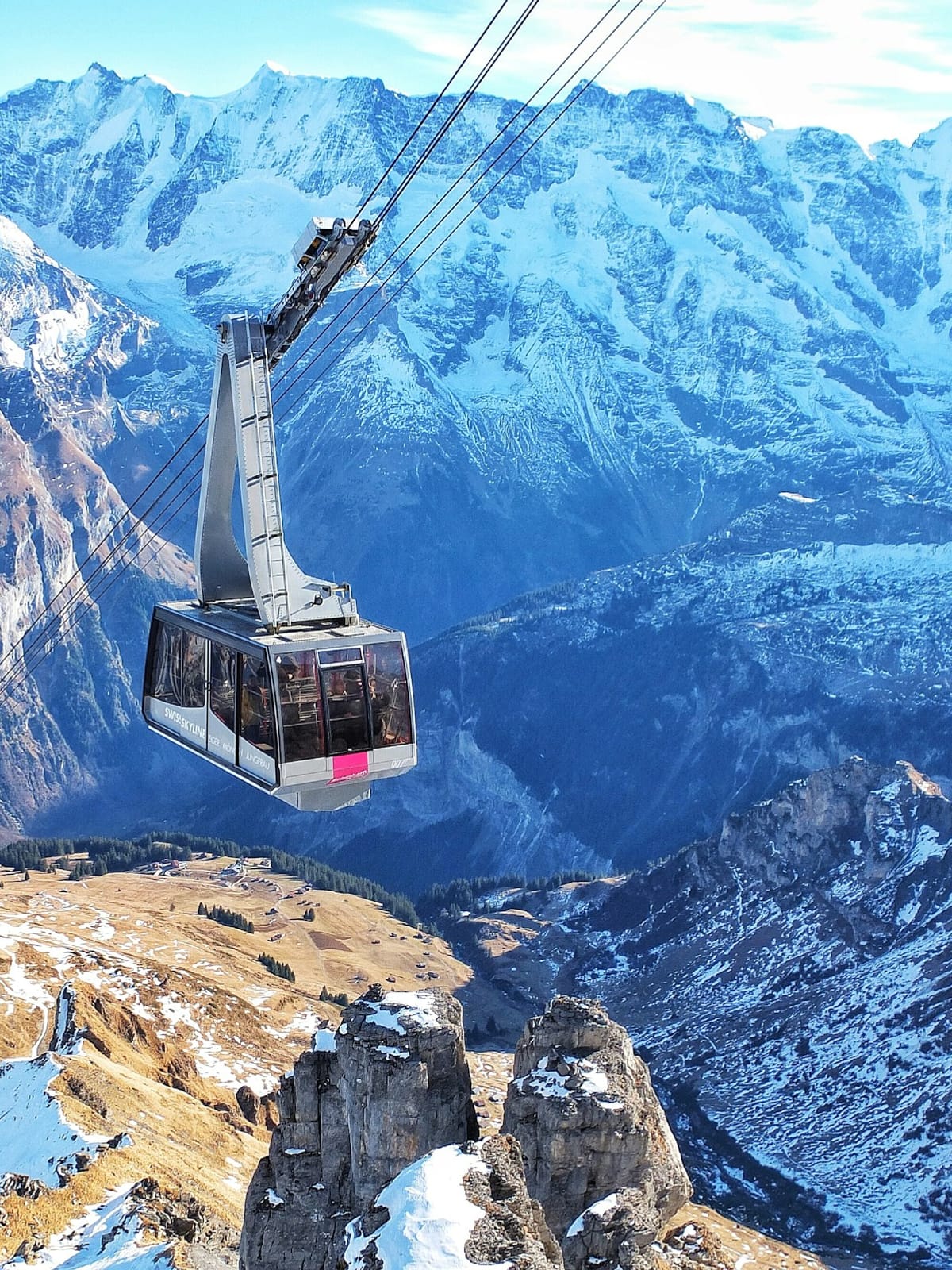
  • Grindelwald First gondola above the treeline
  • Harder Kulm — the panorama of the Jungfrau massif
Meals: Breakfast 4–5★ hotel, Grindelwald or Wengen
Day 5 — Jungfraujoch and the Aletsch
Day 5
5

Day 5

Jungfraujoch and the Aletsch

3,454 metres, the tunnel through the Eiger, and the ice that is a UNESCO World Heritage Site.

The Jungfraujoch railway is one of the great engineering achievements of the 19th century: seven kilometres of tunnel bored through the Eiger and Mönch between 1896 and 1912, with window stations cut directly into the north face of the Eiger. The Eigerwand window station — where the train stops and passengers can step out to a glass-fronted platform and look down 1,700 metres to the valley — is a moment unlike any other in European rail travel. At the summit: the Sphinx Observatory at 3,571 metres, the Ice Palace, and the Aletsch Glacier — 23 kilometres long and 900 metres deep at its thickest, the longest glacier in the Alps and a UNESCO World Heritage Site since 2001. Afternoon descent and a valley walk or the Pfingstegg gondola to the upper glacier moraines.

  • Eigerwand window station inside the mountain
  • Jungfraujoch summit — 3,454 metres
  • Aletsch Glacier UNESCO — largest in the Alps
  • Sphinx Observatory at 3,571 metres
Meals: Breakfast 4–5★ hotel, Grindelwald or Wengen
Day 6 — Zermatt: The Car-Free Village
Day 6
6

Day 6

Zermatt: The Car-Free Village

The Matterhorn, the museum of alpinism, and the cemetery of those who tried.

Transfer from the Bernese Oberland to Zermatt via Brig: the Rhône valley at its widest, the vineyards of the Valais beginning to appear on the south-facing slopes, and then the narrow valley south to Zermatt — car-free since 1930, the only approach by electric shuttle from Täsch. The Matterhorn appears at the end of the main street. The afternoon in Zermatt: the Matterhorn Museum, whose collection includes the original equipment from Edward Whymper's first ascent in 1865 and the cut rope that caused the deaths of four of his seven companions on the descent — the defining incident in the history of alpinism. The Mountaineers' Cemetery, where the names carved on the stones form a catalogue of the 20th century's most significant alpine climbers. The Matterhorn Glacier Paradise cable car to 3,883 metres for the summit view of the Matterhorn from above.

  • Zermatt car-free village
  • Matterhorn Museum — Whymper's rope, cut on the first descent
  • Mountaineers' Cemetery
  • Matterhorn Glacier Paradise to 3,883 metres
Meals: Breakfast 4–5★ hotel, Zermatt
Day 7 — Glacier Express to the Engadin
Day 7
7

Day 7

Glacier Express to the Engadin

8 hours, 91 tunnels, 291 bridges — Zermatt to St. Moritz.

The Glacier Express is the slowest express train in the world and the most scenic. It takes eight hours to travel 291 kilometres from Zermatt to St. Moritz, and each hour offers a different landscape: the Valais vineyards above Visp, the upper Valais of the Rhône glacier (retreating visibly since 1900), the Oberalp Pass at 2,033 metres in the bare moonscape of the Uri Alps, the Surselva gorges where the Rhine is a narrow green ribbon forty metres below the viaducts, and the Landwasser Viaduct — the 65-metre stone arch that carries the track in a curve through a limestone cliff face above the Landwasser valley. Reserved panorama car seats are arranged; lunch in the dining car is served as the landscape changes from German-speaking Graubünden to Romansh-speaking Engadin. Arrival in St. Moritz as the afternoon light falls on the lake.

  • Glacier Express panorama car — eight hours of mountain scenery
  • Oberalp Pass at 2,033 metres
  • Landwasser Viaduct — the stone arc through the cliff face
  • Dining car lunch as Graubünden turns to Engadin
Meals: Breakfast 4–5★ hotel, St. Moritz
Day 8 — The Engadin: The Plateau at the End of the World
Day 8
8

Day 8

The Engadin: The Plateau at the End of the World

The high valley where Nietzsche wrote his most important book.

The Upper Engadin is a plateau at 1,800 metres above sea level between the Bernina massif to the south and the Albula Alps to the north, carved by glaciers into a long valley of elongated lakes. The quality of light — the combination of altitude, southern latitude, and the dry föhn wind — has drawn artists and writers for two centuries. Nietzsche came to Sils Maria each summer from 1881 to 1888 and wrote Thus Spoke Zarathustra here; his house is still open to visitors. Segantini spent the last decade of his life in the Engadin and his triptych of life, nature, and death — painted between 1896 and 1899 — is in the Segantini Museum in St. Moritz. The morning in Sils Maria and the Forno valley. The Bernina Express in the afternoon: the UNESCO-listed railway from St. Moritz over the Bernina Pass at 2,253 metres and down to Poschiavo in the Italian valley — the most dramatic altitude change of any adhesion railway in Europe, descending 1,800 metres in two hours.

  • Sils Maria — Nietzsche's summer house and the Forno valley
  • Segantini Museum — the Engadin triptych
  • Bernina Express UNESCO over the pass to Poschiavo
  • Upper Engadin lakes at 1,800 metres
Meals: Breakfast 4–5★ hotel, St. Moritz
Day 9 — Ticino: Mediterranean Switzerland
Day 9
9

Day 9

Ticino: Mediterranean Switzerland

South of the Alps, the language changes and so does everything else.

The transfer from St. Moritz to Ticino takes two hours via the Maloja Pass — descending from the Engadin plateau through the Maloja gorge into the Val Bregaglia, past the granite peaks of the Sciora and Badile, and then into the Italian-speaking Switzerland that lies south of the Alps. Lugano sits above its lake in a landscape of palm trees and Mediterranean vegetation. The funicular from the lakeside to the old town, the Parco Ciani along the water, and the Lugano Museo d'Arte della Svizzera Italiana in the Palazzo Reali. Boat across Lago Maggiore to the Brissago Islands — a botanical garden on two small islands in the Italian section of the lake, where the collection of subtropical plants belongs to a climate zone three hundred kilometres south of Basel. Lunch on the boat or at the islands. The evening in Lugano at a restaurant that serves the Ticinese table: risotto, osso buco, and the local Merlot.

  • Maloja Pass descent — Engadin plateau to the Italian valleys
  • Lugano and Mediterranean Switzerland
  • Brissago Islands botanical garden by boat
  • Ticinese dinner — risotto, Merlot
Meals: Breakfast 4★ hotel, Lugano
Day 10 — Geneva: The International City
Day 10
10

Day 10

Geneva: The International City

The Red Cross, the UN, and the most elegant lake in Switzerland.

The train from Lugano to Geneva takes three hours along the north shore of Lake Geneva — passing Lausanne (the Olympic capital, the Musée Cantonal des Beaux-Arts, and the lakefront at Ouchy), Vevey (Charlie Chaplin's home for the last twenty-five years of his life, and the Nestlé headquarters), and Montreux, where the Château de Chillon sits on its lake island unchanged since the 12th century. Geneva is the conclusion: the seat of the United Nations European headquarters, the International Red Cross, the World Trade Organization, and eighty other international bodies, in a French-speaking city on the lake. The old town (Vieille-Ville) on the hill above the Rhône, the Reformation Wall with its colossal carved figures of Calvin and Farel, and the Jet d'Eau — 500 litres per second shot 140 metres into the air above the lake. Dinner at a Geneva brasserie: the boîte de fromage, the lake fish perch fillets, the local Chasselas white wine.

  • Train along the Lake Geneva Riviera — Montreux and Château de Chillon
  • Geneva Vieille-Ville and the Reformation Wall
  • The Jet d'Eau at dusk
  • Final dinner — lake perch, Chasselas, and the Swiss table
Meals: Breakfast 5★ hotel, Geneva
Day 11 — Departure from Geneva
Day 11
11

Day 11

Departure from Geneva

The last morning by the lake.

Geneva in the morning before the airport: the Marché de la Place de la Fusterie if it is a Saturday, or the Plainpalais flea market on Wednesdays and Saturdays. The Patek Philippe Museum on the Rue des Vieux-Grenadiers — the finest watchmaking collection in the world, five centuries of horology in a converted 18th-century mansion, and the only place to understand why Swiss watches cost what they do. The Quai du Mont-Blanc along the north bank of the lake, where the Alps are visible on clear mornings across the water, and the Jet d'Eau is the first and last thing you see of Geneva. Your private driver transfers you to Geneva Airport at the agreed time.

  • Patek Philippe Museum — the definitive watchmaking collection
  • Geneva morning — market or lake promenade
  • Final view of the Jet d'Eau and the lake
  • Private transfer to Geneva Airport
Meals: Breakfast

Where You'll Stay

Hand-picked hotels, every night.

We choose properties for character, location, and the kind of service that makes you feel looked after — not just checked in. Every hotel can be swapped for an alternative if you prefer.

4–5★ hotel, Basel

Basel

1 night

4–5★ hotel

City centre or Rhine waterfront

Basel is compact; central hotels are within walking distance of both art museums

4–5★ hotel, Bern

Bern

1 night

4–5★ hotel

Altstadt

Historic properties within the medieval arcaded city are the best choice

4–5★ hotel, Lucerne

Lucerne

1 night

4–5★ hotel

Old town or lakefront

Lakefront properties offer direct views of Mount Pilatus and the Rigi

4–5★ hotel, Grindelwald / Wengen

Grindelwald / Wengen

2 nights

4–5★ hotel

Village centre

Grindelwald for car access; Wengen is car-free with direct Jungfrau views

4–5★ hotel, Zermatt

Zermatt

2 nights

4–5★ hotel

Village centre

Car-free village — luggage transferred by electric vehicle

4–5★ hotel, St. Moritz

St. Moritz

2 nights

4–5★ hotel

Village or lakefront

Historic Palace-style hotels and boutique alpine properties both available

4★ hotel, Lugano

Lugano

1 night

4★ hotel

Lakefront

Lakefront properties are the most atmospheric in the Mediterranean Swiss style

5★ hotel, Geneva

Geneva

1 night

5★ hotel

Lakefront or Vieille-Ville

Final night — lakefront properties offer the morning lake view at departure

Hotels shown are indicative of the standard we book. Upon request, we will provide a detailed itinerary with specific hotel options tailored to your preferences and budget.

What's in the Price

Included

  • 10 nights in 4–5★ hotels and mountain properties
  • Daily breakfast at each hotel
  • Welcome dinner in Basel
  • Private airport transfer in Basel or Zurich
  • All private vehicle transfers
  • Glacier Express panorama car (Zermatt to St. Moritz)
  • Bernina Express (St. Moritz over the Bernina Pass)
  • Jungfraujoch railway tickets
  • Matterhorn Glacier Paradise cable car
  • Mount Pilatus cogwheel railway
  • Brissago Islands boat trip
  • Lucerne private guide
  • Matterhorn Museum entry
  • Einstein Museum Bern
  • Segantini Museum St. Moritz
  • Kunstmuseum Basel and Fondation Beyeler entry
  • Sils Maria — Nietzsche House
  • All entrance fees for included sites
  • 24/7 travel specialist support
  • Hamilton & Chase digital travel booklet with detailed reading list for each region

Not Included

  • International flights to Basel or Zurich / from Geneva
  • Travel insurance (required — we can arrange on request)
  • Meals not listed
  • Personal expenses
  • Gratuities for guides and drivers
  • City tax (collected by hotels)

Good to Know

  • This itinerary uses Basel or Zurich as the arrival airport and Geneva as the departure — an open-jaw arrangement that is straightforward with most major European and transatlantic carriers.
  • The Glacier Express requires advance reservation for panorama car seats — booking as early as possible ensures the best positions.
  • The Jungfraujoch, Schilthorn, and Matterhorn summits are weather-dependent. Your specialist monitors forecasts throughout and re-sequences days where necessary.
  • Switzerland is year-round, but May–October gives full mountain railway and cable car operation, clear visibility, and warm Ticino and Geneva weather. December–March adds winter scenery and skiing.
  • Eleven days is the minimum for this circuit to feel unhurried — guests who have done shorter Swiss itineraries consistently report wishing they had more time.

Make It Yours

Optional add-ons & upgrades.

Every trip is different. These extras can be woven into your itinerary — just let your travel specialist know what catches your eye.

Art Basel extension

Art Basel is held each June and is the most important art fair in the world. We can build this itinerary around the fair dates with access to vernissage events and private gallery visits

Price on Request

Gornergrat, Zermatt

The rack railway to 3,089 metres — twenty-nine four-thousanders, the Gorner Glacier, and the Matterhorn and Monte Rosa from the same viewpoint. A morning addition to the Zermatt stay.

From €75 pp

Helicopter over the Matterhorn

A private helicopter circuit from Zermatt over the Matterhorn, Monte Rosa, and the Zermatt glacier — thirty minutes that shows the scale of the Valais Alps from 4,500 metres

Price on Request

Château de Chillon private visit

The 12th-century island castle on Lake Geneva, the most visited historic monument in Switzerland — Byron's subject in The Prisoner of Chillon, with original 13th-century frescoes, accessible from the Geneva day or the Lake Geneva train route

From €65 pp

"We had always assumed Switzerland was one thing — mountains, cheese, expensive. It is four countries. Basel was unexpected and magnificent. Bern was the best capital city we have ever visited that nobody talks about. The Glacier Express delivered every promise. And Lugano with the palm trees the day after Zermatt — we are still not quite over it. This is the right way to see Switzerland."

Jonathan & Claire H.

Toronto, Canada · Grand Tour of Switzerland, September 2025

Common Questions

Questions about this trip.

Is this the right itinerary for a first visit to Switzerland?

It is the complete version. If you have nine days rather than eleven, consider the Best of Switzerland itinerary, which covers the essential highlights at a slightly faster pace. If you have seven days, the Essence of Switzerland concentrates on the alpine core — Lucerne, Jungfraujoch, Zermatt, Geneva. The Grand Tour is designed for travellers who want to understand the country rather than visit it.

Why does the itinerary arrive in Basel rather than Zurich?

Basel is the right starting point because it is the cultural antithesis of the mountain Switzerland that most visitors expect — and beginning with that contrast (the Rhine, the art, the architecture) makes everything that follows more interesting. Zurich arrival is equally possible; your specialist will advise based on your flight options.

Private Package Journey

Grand Tour of Switzerland

11 days / 10 nights

From €4,190

per person

Ready to go?

Share a few details and a specialist will reply within one business day.

Prefer to Talk?

Available Mon–Fri 9am–6pm CET.
On-trip support is 24/7.

Plan My Trip